
What needs to be done and when?
Things to do in the first week
Apply for a death certificate from the registry office – request several copies, as banks, insurance companies and government agencies each require an original.
You should also check whether there is a will or an inheritance agreement. You may be able to find out by speaking to the deceased’s solicitor or other relatives. If you do find one, you must submit it to the probate court without delay.

Please note the 6-week deadline
From the moment you find out about the inheritance, you have six weeks to renounce it – even if there is no will. If there is no will, the time limit starts from the moment you become aware of the death, for example through relatives. If there is a will, the time limit starts from the date you receive the letter from the probate court.
It may be advisable to renounce the inheritance if the estate is insolvent, i.e. if the deceased’s debts exceed their assets. However, there are also ways to limit your liability – our solicitor can advise you on this on a case-by-case basis. A legal assessment is particularly important in this situation, as the rest of the probate process depends on this decision.
Please give us a call: 📞 +49 911 6695770

Clarify any outstanding issues
Check whether other people are entitled to a share of the estate – for example, through statutory inheritance rights – and whether the estate includes property or shares in a business. Both factors can have a significant impact on the next steps.

Legal advice
Whether you wish to renounce an inheritance, want to assess your tax situation, or simply want to know the best course of action: advice on inheritance law will help you make the right decisions.

Apply for a certificate of inheritance
If you accept the inheritance, you will in many cases need a certificate of inheritance, for example to access bank accounts or transfer ownership of property.
You should apply for the certificate of inheritance at the probate court with jurisdiction over the deceased person’s last place of residence.
Intestacy
Who inherits if there is no will or inheritance agreement?German inheritance law follows a clear order of priority – known as the order of succession. Anyone in a higher order of succession excludes all others. The infographic (only in German language) below provides an overview of the key scenarios:
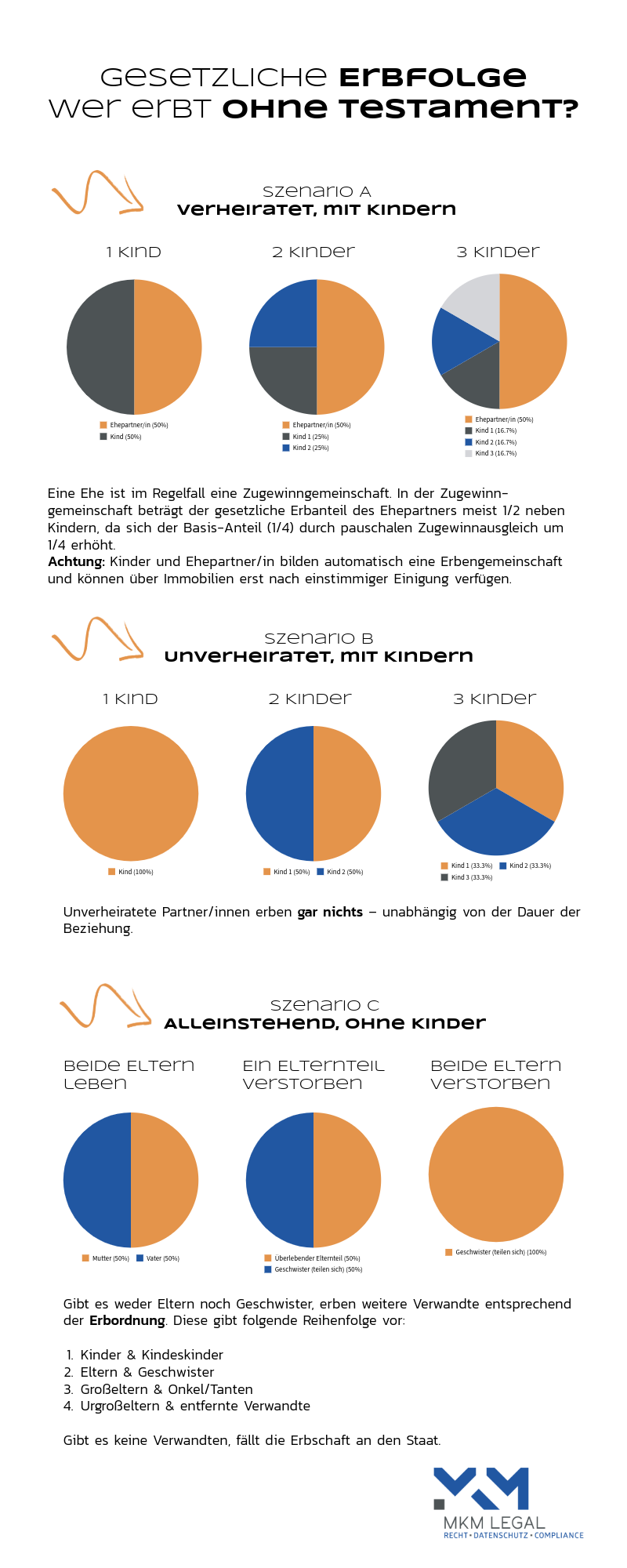
You can also download this infographic for free from the downloads section.
What role does the probate court play?
The Probate Court is part of the Local Court and deals with inheritance matters. The Probate Court at the deceased’s last place of residence has jurisdiction; it automatically initiates probate proceedings upon learning of a person’s death. This information is usually provided by the Registry Office.
Procedure in the event of a death
First, the court checks whether a will or inheritance contract has been registered anywhere. This is the purpose of the Central Register of Wills maintained by the Federal Chamber of Notaries, which records notarised wills and inheritance contracts. Holographic wills that have been filed with the probate court are also included in this register.
If you find a will, you must submit it to the probate court without delay (section 2259 of the German Civil Code). In this case too, the probate court will then take care of the next steps.
What happens if no will is found?
If no will or inheritance agreement is found, the rules of intestate succession apply. This means that the law determines who inherits – and in what order.
The court will then identify the legal heirs, as far as it is able to do so. Upon application, it will issue a certificate of inheritance – the official document that proves your status as an heir.
Issuing of a certificate of inheritance
As an heir, do I need a certificate of inheritance?
Not always – but often. Banks, land registries and government agencies usually require a certificate of inheritance before granting access to the estate. Particularly if the estate includes property, you will usually have no choice but to obtain a certificate of inheritance. The application is made to the probate court, requires a statutory declaration and involves costs based on the value of the estate.
Legal advice on inheritance matters
Why it is worth seeking legal advice on inheritance matters
Experienced support:
We guide you step by step through the organisational and regulatory challenges that arise following a death. We provide personalised and empathetic advice throughout the process.Avoiding pitfalls:
Missed deadlines, incorrect applications for a certificate of inheritance, overlooked statutory share claims … in inheritance law, mistakes are often irreversible – missed deadlines or claims can rarely be rectified after the fact.Costs versus added value:
Legal advice on inheritance law is usually a manageable investment relative to the value of the estate – and offers tangible benefits: better outcomes, avoided disputes and a lower tax burden.Reducing your tax burden:
With the right strategy, inheritance tax can often be significantly reduced, for example through the targeted use of tax allowances or forward-planning. We provide comprehensive advice and can also assist you with your inheritance tax return.Peace of mind in a difficult situation:
A probate case is rarely just a legal formality. We take care of the legal complexities so that you can focus on what really matters.
Your contact at MKM LEGAL
Carmela Caiazza has been practising as a solicitor since 2012 and has been advising clients on inheritance law ever since, alongside her specialisation in employment law.
An inheritance case where there is no will often raises more questions than one might initially expect – both legally and within the family. Ms Caiazza can help you gain clarity and take the next steps with confidence.

CaiazzaLawyer I Counsel
Specialist lawyer for labor law