

The Most Important Points in 60 Seconds
- There is no requirement to label everything created using AI. The law applies only to certain situations.
- Three cases clearly require labeling:
- Chatbots
- Hyper-realistic images, videos, and voices
- Unverified AI-generated text on topics of public interest
- The invisible watermark provided by AI providers doesn’t do the work for you. You must provide the visible notice to your readers, customers, and viewers yourself.
Who is responsible—and for what?
The law distinguishes between two roles. Technical labeling is the responsibility of AI providers. Their duty as companies is to provide a visible notice to the people who see, hear, or read their content.
- Role 1: The AI provider
OpenAI, Google, Microsoft, Anthropic, Mistral, and others. They must technically label their results: invisibly, in a machine-readable format, using watermarks and metadata. You won’t notice any of this in your daily life. - Role 2: AI Operator (= Your Company)
All individuals who use an AI system in a professional capacity. You must provide visible information to users: in the chat window, on the image, or below the text—in a way that catches their attention upon first contact.
The provider’s watermark does not fulfill your obligation. Both must appear side by side.
An Overview of the Four Obligations
Article 50 of the AI Regulation, effective as of August 2, 2026.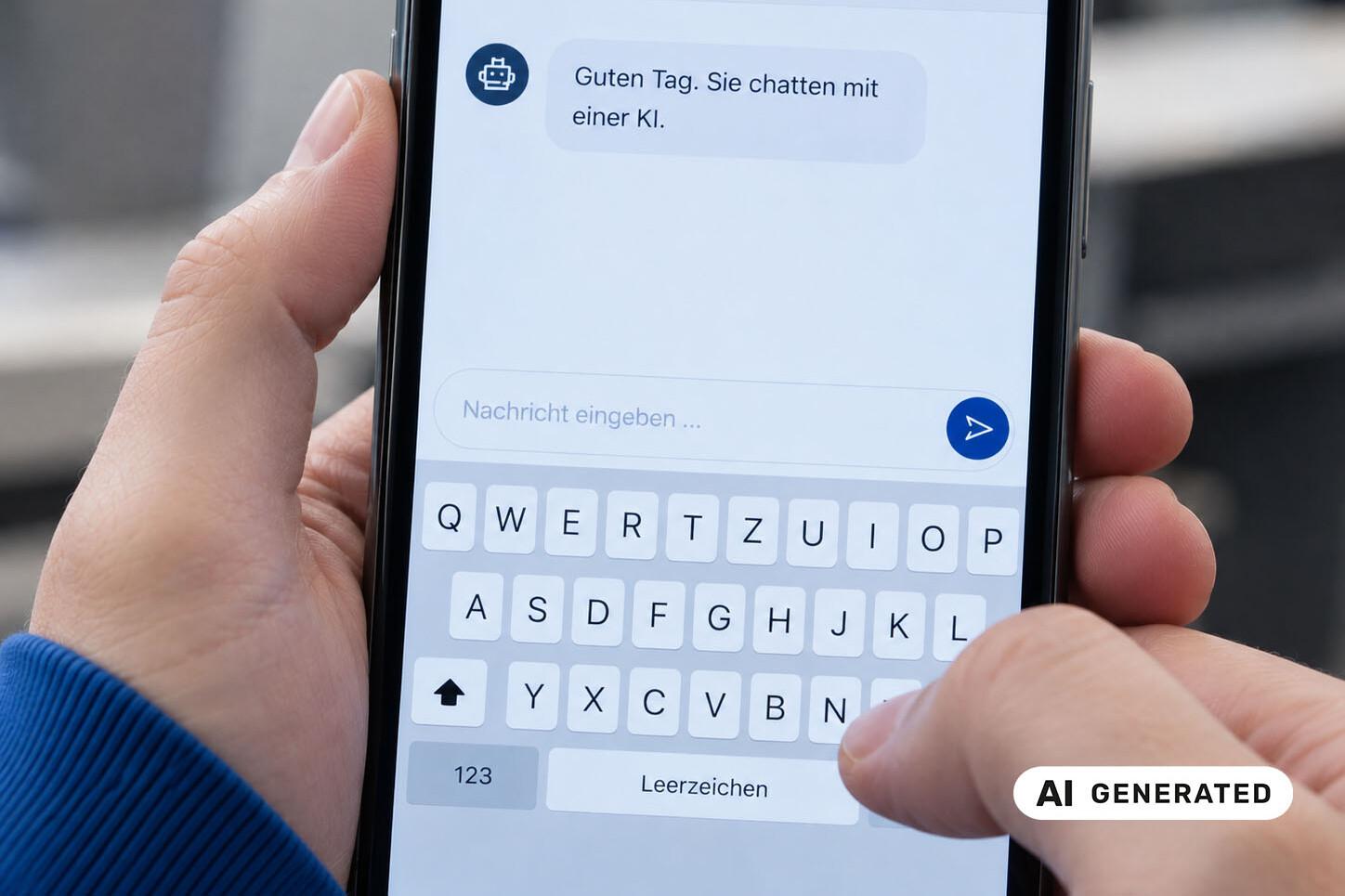
1. The Chatbot Notice
Anyone who talks or writes with an AI needs to know this. The notice should be placed at the beginning, not in the Terms and Conditions. Exception: It’s obvious to everyone anyway.
Applies to: Providers and, in practice, your website

2. Technical Labeling
AI results bear an invisible identification mark. Providers are responsible for this—for older AI systems, effective December 2, 2026.
Applies to: AI providers
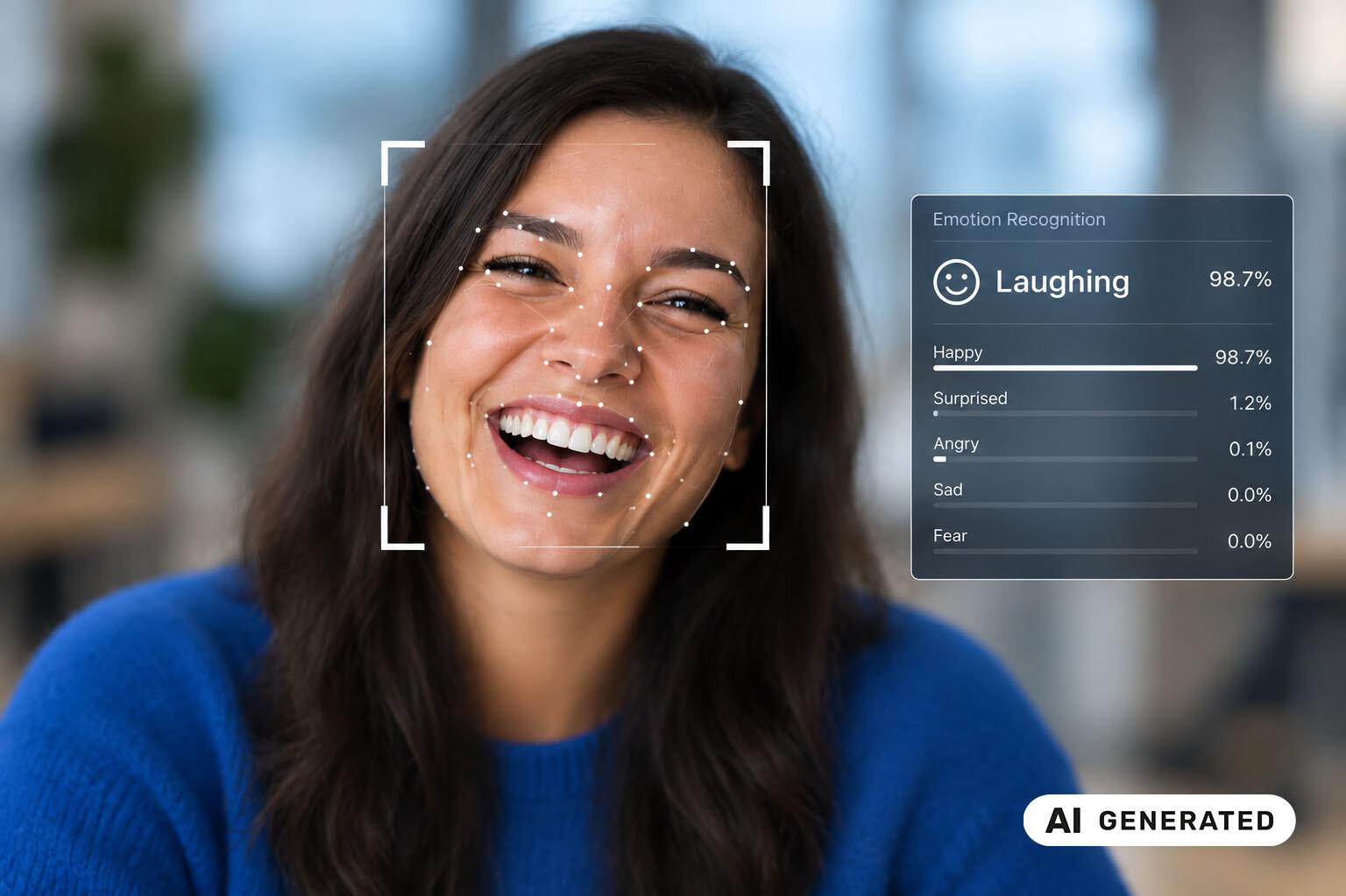
3. Emotions and Biometrics
Systems that detect emotions or classify people based on physical characteristics must be disclosed to the individuals concerned.
Applies to: Your company; in addition, you should comply with data protection laws in this regard.

4. Deepfakes and Text
Images, videos, and voices that appear deceptively real must be disclosed. The same applies to AI-generated texts published on topics of public interest—unless a human has reviewed them.
Applies to: Your company
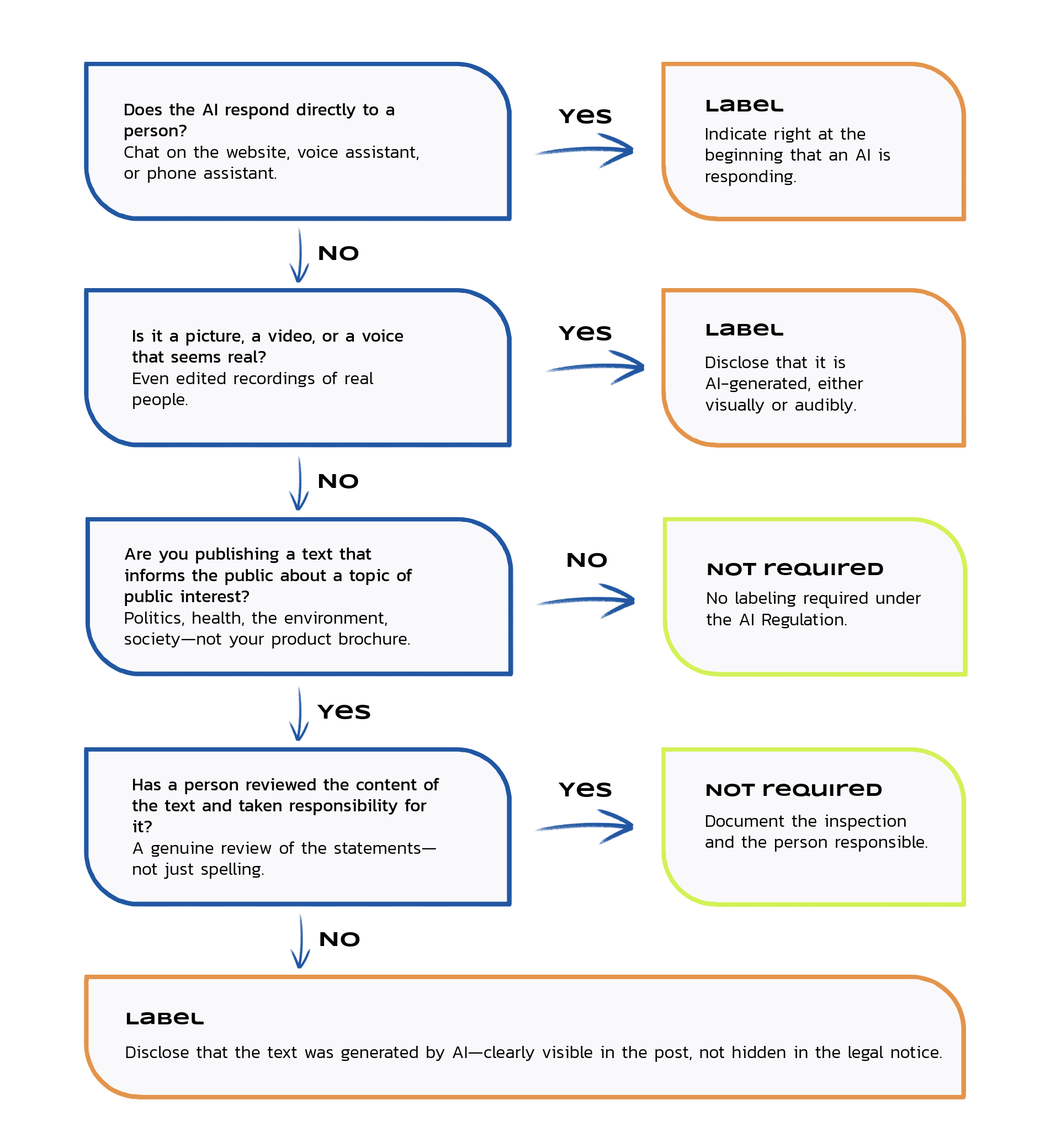
In what cases do I need to label my AI-generated content?
Four questions will provide the answer in the vast majority of cases. We’ve clearly laid them out for you in the following chart:
Thirteen Examples from Everyday Life
Typical situations in businesses—and how they should be classified based on current guidelines:
| AI labeling required? | |
|---|---|
Customer service chatbot on your website | |
AI phone assistant that schedules appointments | |
Photorealistic advertising image of a scene that never existed | |
Comic or fantasy motif, such as a flying dragon | |
Product photo cropped, sharpened, and denoised using AI | |
Product photo with a background generated by AI | |
Cloned voice of the executive team in a promotional video | |
Blog post about your products, AI-drafted, editorially reviewed | |
Article on a sociopolitical topic, published without review | |
Internal presentation, minutes, or memo | |
AI Translation of Your Newsletter | |
Source code from an AI programming assistant | |
Job application tool that analyzes emotions |
Please note: YouTube, Meta, TikTok, and other platforms require specific disclosures regarding AI content. These rules apply in addition to the law—and are enforced more quickly than by any government agency.
Any questions or concerns?
The Gray Areas
In three cases, classification is difficult. Until the courts have ruled, a rule of thumb can help in each instance.



What do the providers’ watermarks do?
Google, OpenAI, Anthropic, and Microsoft embed invisible markers and signed source data in their results. For you as a business, this means:
- It’s the providers’ responsibility, not yours. Your visible notice to readers remains unaffected.
- Don’t rely on this. Paraphrasing, copying, or taking a screenshot destroys such traces—studies show very high loss rates.
- Detection tools can be wrong in either direction. An AI detector is not proof—neither for nor against—that a human is the author.
Deadlines and Next Steps

Labeling Requirements Take Effect
As of August 2, 2026, the labeling requirements of the AI Regulation take effect. Chatbots, hyper-realistic AI images, videos, and voices, as well as unverified AI-generated text on public topics, must be disclosed.

Labeling Required for Older AI Systems as Well
Starting December 2, 2026, older AI systems must also label their results in a way that is invisible to users but machine-readable. This requirement applies to AI providers, not users.

Detection Tools Must Be Compatible
Starting February 2, 2027, the tools used to detect AI markers must be compatible with one another. This requirement also applies to AI providers.

New Oversight in the Media Sector
Starting August 1, 2027, state media regulatory authorities are to monitor the use of AI by publishers and broadcasters. The inter-state treaty governing this still requires approval from the states (as of October 2026).
How We Support You
Customized Legal Advice
Are you unsure which AI-generated content you need to label? We review your specific cases and work with you to establish the necessary processes—from conducting an initial assessment to drafting an AI policy and negotiating contracts with service providers. In doing so, we also take into account advertising law, copyright law, and professional and industry-specific regulations.

MärtinLawyer I Equity Partner

Klufmöller LL.M.Lawyer I Counsel
Specialist lawyer for copyright and media law
Specialist lawyer for intellectual property law
Practical AI Workshop
Do you want your team to work confidently with AI? In our workshop, we’ll work together on your own use cases and explain the legal considerations, always keeping in mind what works best in day-to-day work.